A short immersion along Japan’s famous long-distance walk
The Shikoku Henro trail, also known as the 88 temple trail, is not only Japan’s most well-known pilgrimage, but also an immersive cultural experience unlike anything most visitors get to experience. As the name suggests, it takes pilgrims on a journey along 88 temples on Shikoku while showing off the island’s lush forests, idyllic coastline and wild mountain valleys.
The 88 temples of the Shikoku Henro trail represent the life and travels of the Buddhist monk Kūkai, more commonly known as Kobo Daishi, who is believed to have established or visited many of these temples. Of course, not everyone will have the time to walk in Kobo Daishi’s footsteps and complete all 1200 kilometres (750 miles) over the course of almost two months.
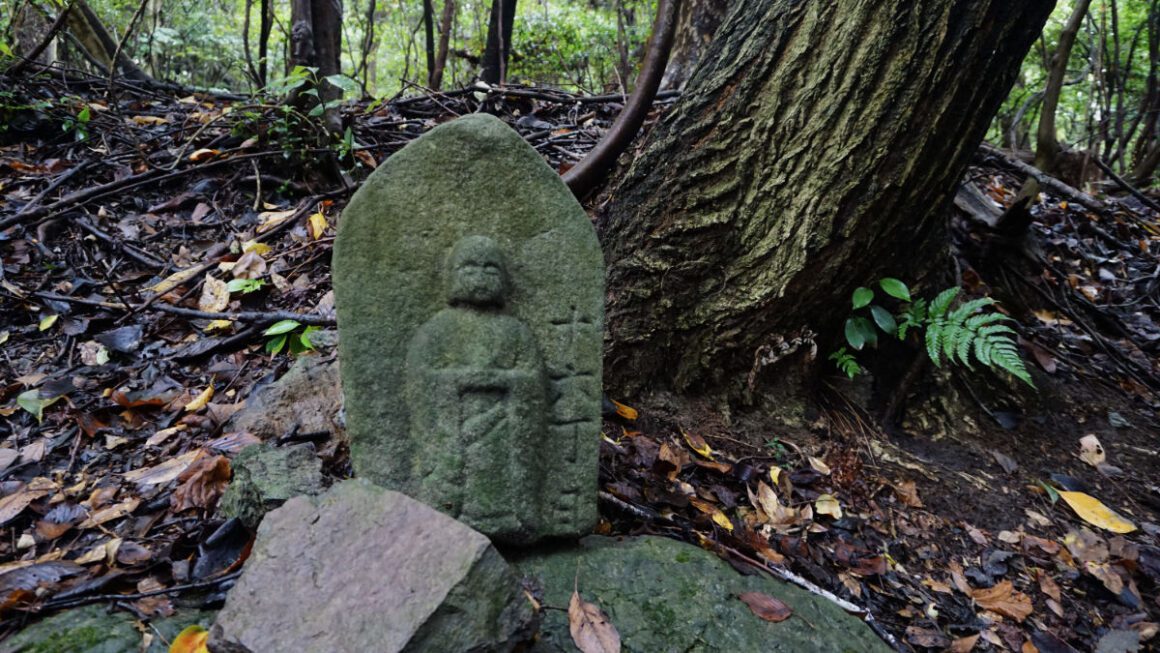
For those short on time but full of intent, the last 5 days of this pilgrimage offer an easily accessible experience that still allows for a peek into one of Shikoku’s most defining cultural landmarks. This is arguably a very urbanised section of the Shikoku Henro trail, but it does allow for a slow exploration of Kagawa’s alleyways and suburbs that offer a unique look into the everyday lives of local residents. The urban sections can also be (partly) skipped by taking trains or buses, so you can choose to focus more on the forested ‘green’ parts of the route.
This quick guide will tell you how to get this 5-day adventure started, what you should bring, and where to stay. Read on to find a detailed itinerary and downloadable .gpx files below!
Contents
- Preparation
– Mobile internet in Japan
– When should you visit?
– The Henro outfit - Navigation and route
– Public transportation: how to get around? - Where to stay on the Shikoku Henro trail?
- What should you bring?
- A 5-day Henro itinerary for Kagawa
Preparation
To get started on the last few sections of the Shikoku Henro trail, you’ll need to make your way to Kagawa prefecture first. Luckily, this area is quite easy to reach from Osaka, leaving you with one less excuse to start your feet on this adventure.
Once there, most visitors will choose Takamatsu city for their first few nights. It’s big enough to provide everything you could need, and it’s in a convenient spot to return to once you’ve finished the walk at Okubo temple (number 88).
Another option, and one I personally would recommend, is to stay in Kotohira. This charming little town, nestled up against a steep hill is not only a good place from which to start your walk along the Henro trail, but it makes the perfect base to explore this part of Shikoku as well.
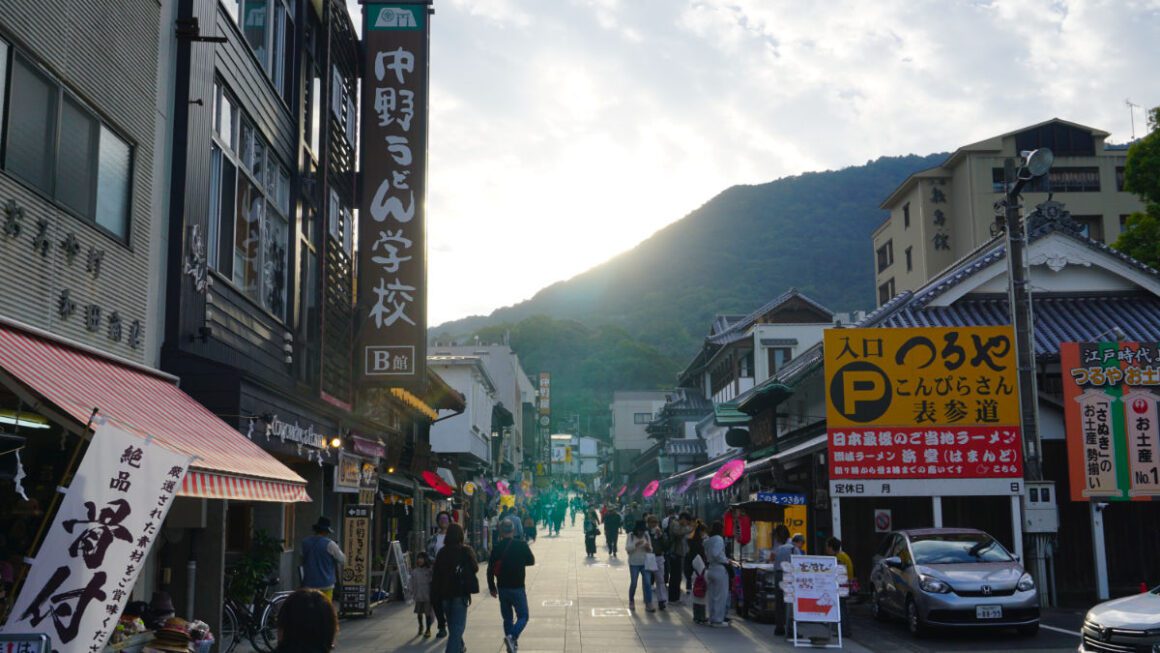
The town has a good connection to Shikoku’s JR train network, as well as to a secondary local train line. In addition, it’s a popular destination for domestic tourists, who flock to the town on weekends to visit its famous mountain shrine and sample Shikoku’s sanuki-style udon noodles. But the best reason to visit would be for its small-town charm, offering a glimpse into local everyday life, away from the big cities.
Kotohira is also conveniently located near Zentsuji temple (nr. 75), where you can purchase everything you need to complete your traditional Henro outfit (optional, but recommended).
Discover stellar views and unforgettable ridge walks on the Shinetsu Trail in Nagano!
Mobile internet in Japan
Whether it’s to navigate your way through a confusing street grid or to share that breathtaking Shikoku scenery with the world, most modern travellers cannot go without good mobile internet. Luckily, Japan is one of those places where both coverage and affordable data plans are as plentiful as their convenience stores.
The easiest way to get yourself online in Japan is to get an eSIM data plan. The sheer amount of eSIM providers can be overwhelming, so sticking to providers that cater specifically to international travellers (like Ubigi or Saily) will make your choice a bit easier.
But what if your phone doesn’t support eSIMs? Physical SIM-cards can be bought in many places, but these are not always available for tourists or short-term visitors (as they often require a long-term subscription to a local provider). Tourist SIM-cards can usually be bought in airports, but if you missed your opportunity after landing, they can also be found in convenience stores like 7-Eleven. These tend to only be available for shorter periods (5-7 days), so the cards available at airports are your best bet if you’re looking for a physical SIM-card.
Note: not every convenience store will have SIM-cards available, so trying the larger stores is usually your best bet. Sometimes you’ll see both eSIMs and physical SIM-cards displayed on a shelf, so make sure you get the type you need!
When should you visit?
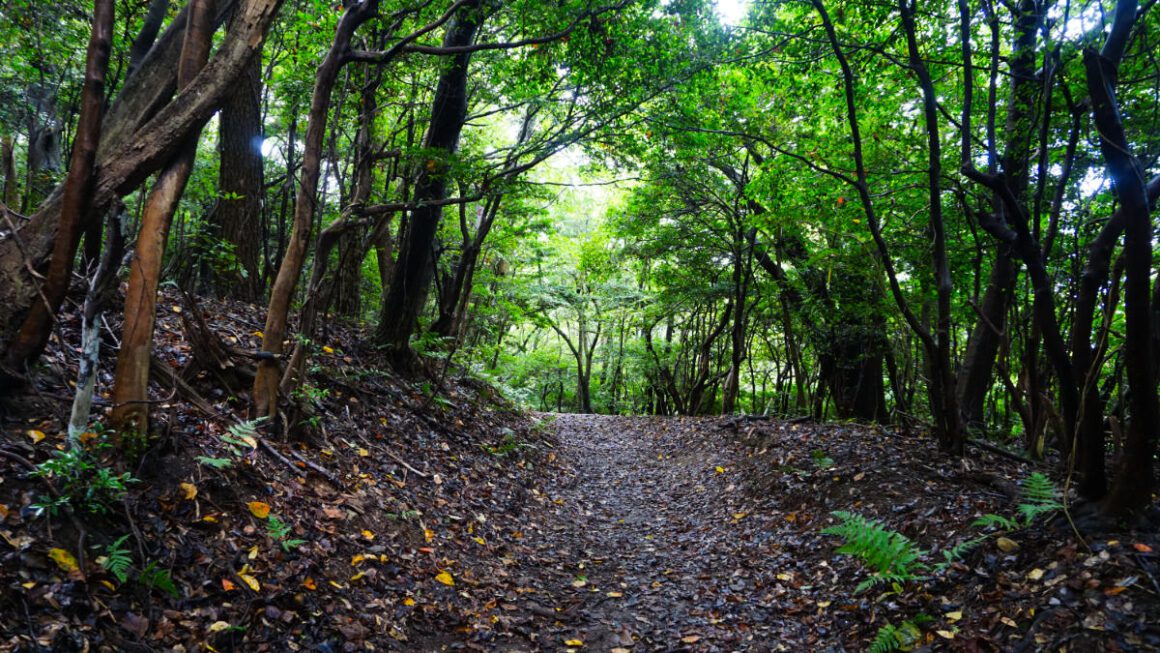
The best time for walking the Shikoku Henro trail (or any sort of hiking in Japan) is in spring and in autumn, from April to June and from September to early November. During this time, temperatures will range between 15-25 C (59-77 F). Keep in mind that Shikoku has its rainy season in late May and June. Winter is not only cold, but accommodation options will be limited as well. Summer can get extremely humid and hot, and is best avoided if you’re not comfortable walking in the sweaty heat.
The Henro outfit
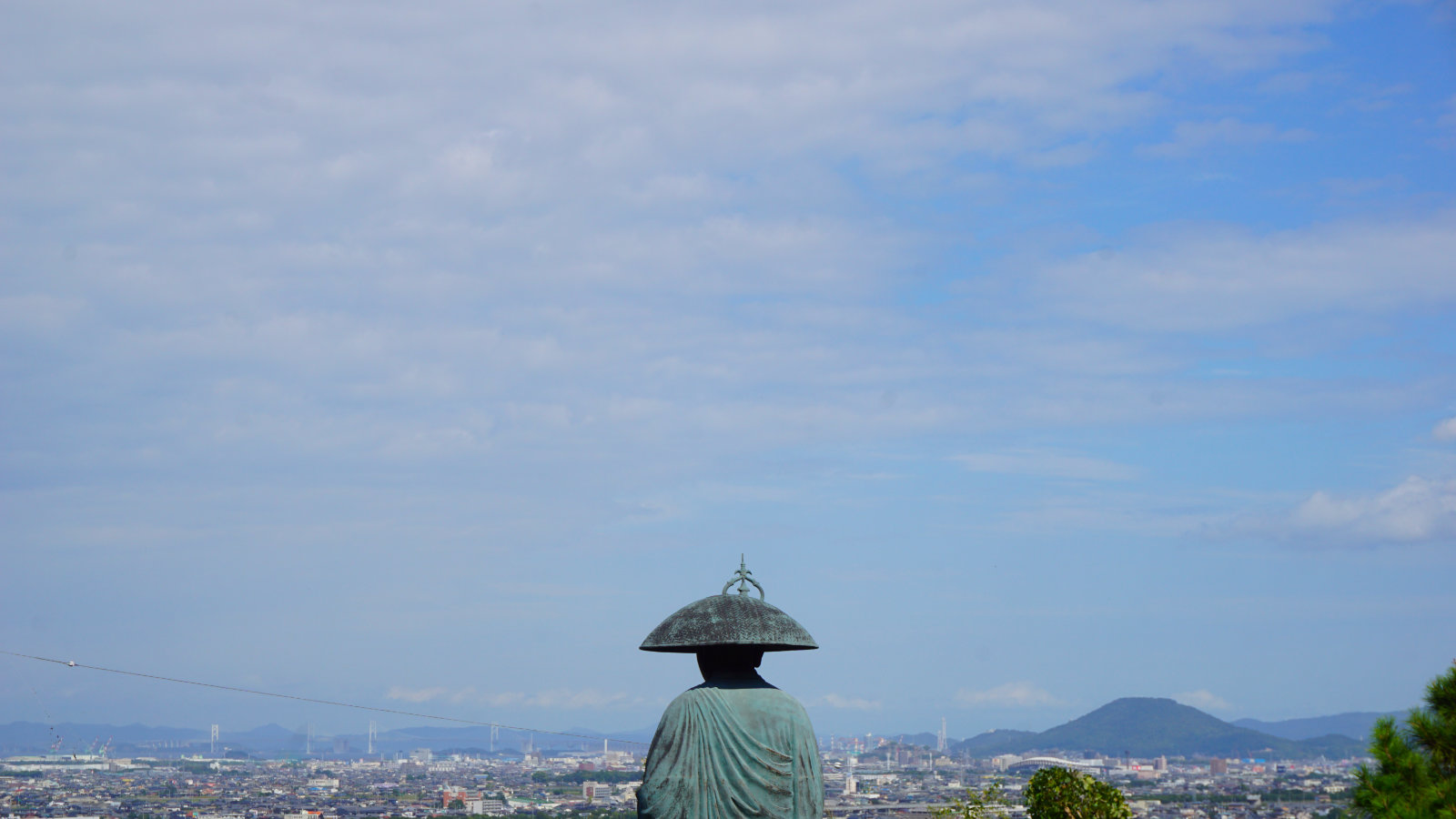
One of the most iconic aspects of the Shikoku Henro trail is the way its pilgrims dress to declare their pilgrimage to the world. For hundreds of years, those walking in the footsteps of Kobo Daishi have donned the traditional hakui and sugegasa (white robe and bamboo hat) to indicate their pilgrim status.
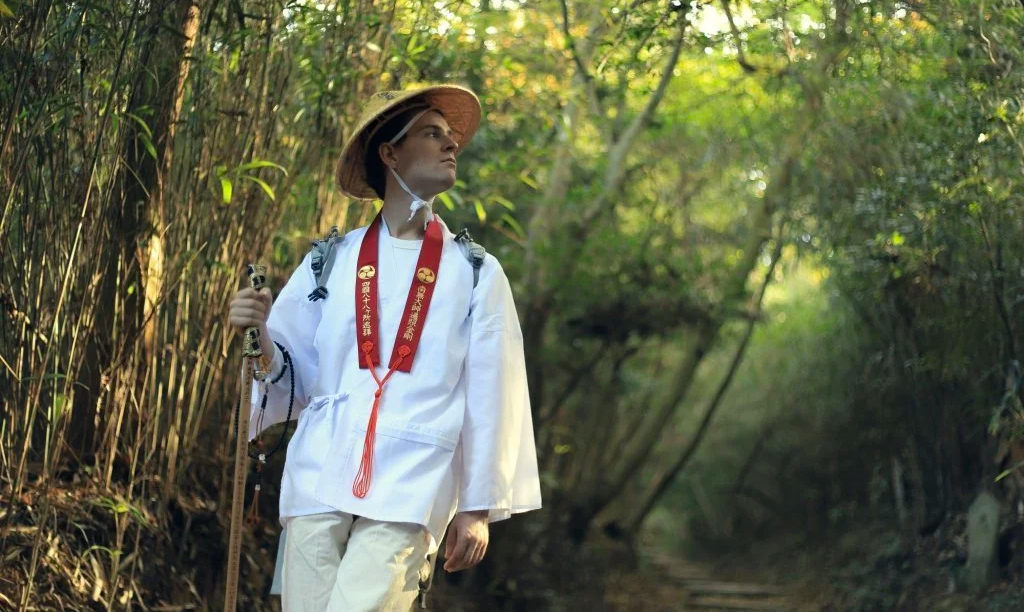
In addition, most pilgrims will carry a kongōtsue (a walking staff that symbolises Kobo Daishi) and a stamp book to collect stamps from every temple. In the Edo period, when the Shogunate prohibited commoners from traveling freely, these stamp books were introduced as a way to verify pilgrim status and functioned as a writ of passage. Most modern pilgrims also carry osamefuda: paper slips with a message of dedication, used as a kind of ‘pilgrim business cards’, left at collection boxes near shrines and handed out to other pilgrims. It is also customary (though not necessary) to give osamefuda to people offering osettai, acts of kindness to support pilgrims.
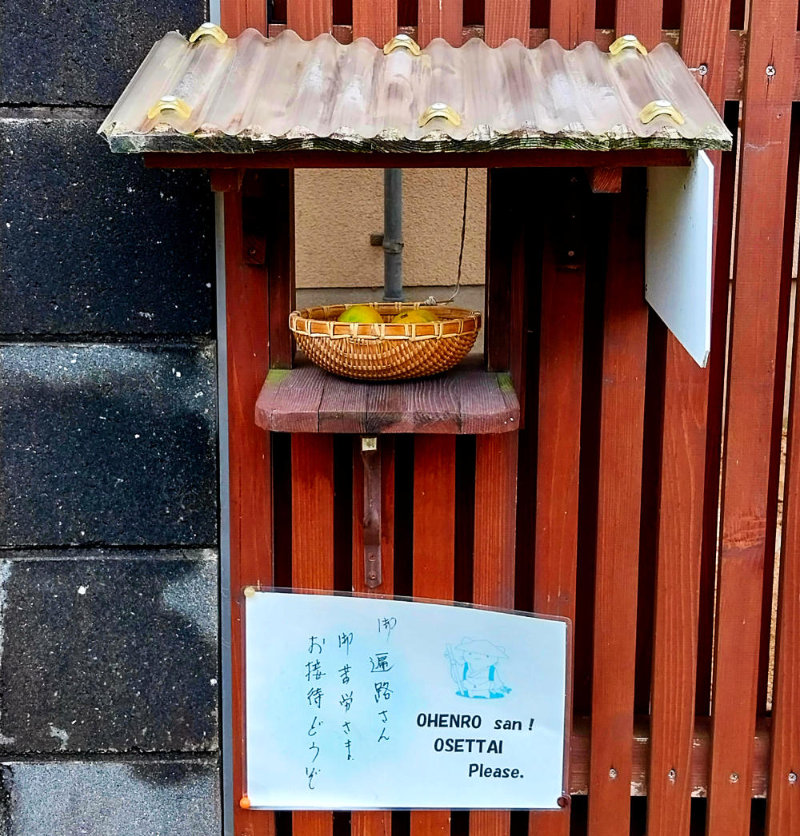
Osettai is another iconic aspect of the Shikoku Henro trail; locals will occasionally offer you candy, drinks, or even small amounts of money to help you on your pilgrimage. These acts are considered as a way to extend the blessings bestowed on a pilgrim to those who assisted them along the way. When offered an act of osettai, it is considered good manners to always accept, and offer nothing but thanks in return.
Wearing the Henro outfit is optional, but by donning the traditional garb you get to fully immerse yourself into a unique cultural experience, and locals will look at you and treat you even more kindly! The temple shop at Zentsuji temple (nr. 75, near Kotohira) can provide you with everything you need.
You can check the official Henro website for more information on what to wear and Henro etiquette (a recommended read!).
Navigation and route
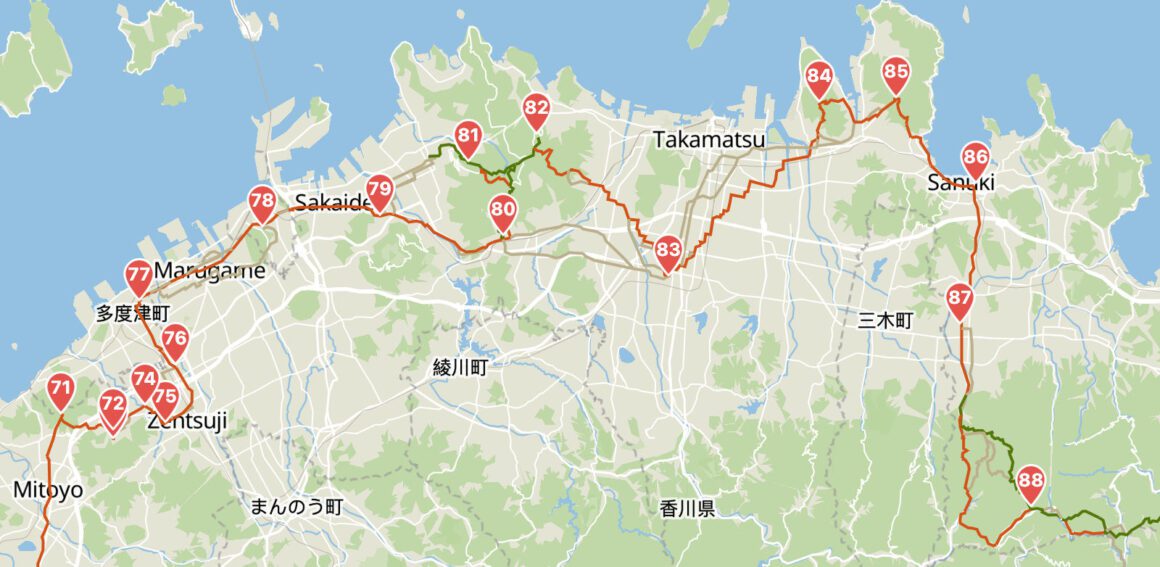
While the full Henro trail takes you all around Shikoku for a whopping 1200 kilometres, this 5-day itinerary only covers the last sections of the pilgrimage, between temples 71 to 88. Each day will cover between 20-30 kilometres (12,5-18,5 miles) on average, about 5-7 hours of walking each day.
You’ll start near Mitoyo, at Bed ‘n’ Chill Shippoya, the first accommodation for this 5-day walking adventure. Over the next days, you’ll walk eastwards to Zentsuji, Takamatsu, and Shido before going south into the mountains for a stunning hike up to the finish at Okubo temple.
The official guidebook for the Shikoku Henro trail can be purchased at Zentsuji temple near Kotohira, and will offer a reliable paper overview of these sections. An excellent and highly recommended digital option would be to download the Henro Helper app (available for Android and iPhone) to your phone. This app will let you navigate the route in daily sections, measure distances, and see rest areas and accommodation options along the way.
The itinerary at the bottom of this page will show you an overview of each day as well, with downloadable .gpx files for each section. To download a .gpx file, click on the title of each section’s overview to go to the Komoot route page. Once there, click on the three dots on the right side of the screen (upper right corner on mobile) to open a dropdown menu. Select ‘Download GPX’ to start the download.
Public transportation: how to get around?
One of the best things about traveling in Japan is the country’s excellent public transportation system, and Shikoku is no exception. The fastest way to get to Kagawa prefecture from anywhere in Japan is to fly to Takamatsu airport. Another way is to take a high speed Shinkansen bullet train to Okayama, but cheaper (and longer) regular train routes are also an option. From Okayama, you’ll then need to transfer to a ‘limited express’ or local train to Kotohira or Takamatsu (depending on where you choose to make your base for the trip).

To get to the start of this 5-day itinerary near Mitoyo, you’ll need to take a local train from Kotohira or Takamatsu to Mino station. From there, it’s a 10-minute walk to Bed ‘n’ Chill Shippoya.
To get back to either Takamatsu or Kotohira after completing the Shikoku Henro trail at Okubo temple, you can take a bus that leaves from the square near the temple to Nagao train station (tell the driver your destination when you get on). From Nagao, a local train service will take you to Takamatsu, and you can change trains at Kawaramachi station to get to Kotohira.
Note: if you are not spending the night near Okubo temple (nr. 88) on your last day, it is important to arrive (and finish) at this temple before 4 pm, as this is when the last bus of the day leaves. There are no other public transportation options available after this time, except for taking a taxi.
Where to stay on the Shikoku Henro trail?
Along the way, you can stay in the local guesthouses and hostels recommended in the itinerary below. You can also choose to stay in one fixed location and travel to and from each section, but this will take significantly more time out of your day.
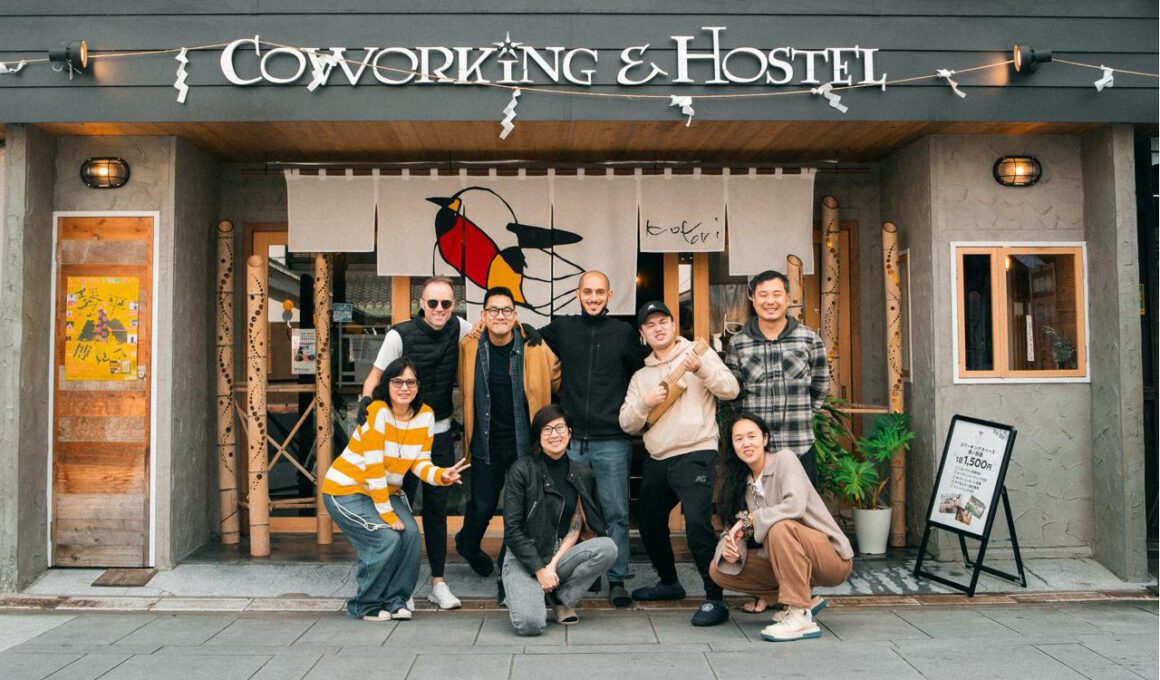
I highly recommend making your base in the town of Kotohira, and store your luggage here as you walk the Shikoku Henro and stay in accommodation along the way. A convenient, English-speaking, and very friendly place to stay in Kotohira is Kotori Coworking and Hostel. Kotori offers private rooms, a dormitory, luggage storage for when you’re walking the Henro, and a coworking space for those that need to clear deadlines before setting off on their pilgrimage. They also have a branch in Takamatsu.
Along the Shikoku Henro trail, you’ll find plenty of options such as hotels, ryokan-style guesthouses, and hostels. Reservations are often a necessity and most of the local guesthouses and hostels require you to call ahead for reservations; making it tricky for those who don’t speak Japanese. My recommendation is to find a local that speaks English to help you out and make the reservations for you.
Luckily, both Kotori and Bed ‘n’ Chill Shippoya at the start of this itinerary have English speaking staff who’ll be more than happy to help you book accommodation along the Shikoku Henro trail. You can also use the Henro Helper app (for Android and iPhone) to find places to stay near the end of each section.
What should you bring?
Like any other long-distance walk, it never hurts to come prepared. Here’s a list of must-bring items on this 5-day adventure on the Shikoku Henro trail:
- Good walking shoes. This goes without saying. Most of the surfaces during these 5 days are suitable for light sports shoes, but some sections can get steep and slippery (especially in rainy weather). Some ankle support is recommended for less experienced walkers.
- Season-appropriate clothing. Bring 2 sets of quick-drying clothing, maybe an extra t-shirt and an extra pair of socks if it’s very warm. Most hotels and guesthouses offer a wash & dry service.
- A small backpack. 20-30 litres should be enough to carry daily essentials and spare clothes.
- Rainproof layers. A jacket and rainproof trousers come in handy during Japanese downpours. If the forecast is mostly dry, a reusable rain poncho is a good lightweight option.
- Snacks. Breakfast and dinner can be arranged at most guesthouses, but make sure to carry some ready-to-eat lunch or snacks for when you need an extra boost of energy. Even if your accommodation doesn’t serve food, you’ll never be far from a restaurant or convenience store.
- Mosquito spray. Thank me later.
- Your Henro outfit. White robe, bamboo hat, walking staff and prayer slips for full immersion!
- Your smartphone and charger. Essential for translation, navigation, and snapping beautiful shots. Don’t forget to bring a converter for Japanese power outlets.
A 5-day Henro itinerary for Kagawa
The itinerary below will show you the details for each daily section, what to expect, where to stay, and even where you can skip some urban sections (purely optional, of course)! These daily sections match the ones on the Henro Helper app (for Android and iPhone), so it is highly recommended to use this app for daily navigation.
It’s also a good idea to start each day no later than 09.30 am. This will give you enough time for breaks, lunch, sightseeing, and other distractions during the day. You can check the estimated walking time for each day, as well as total kilometres and an elevation profile, in the route overview at the top of each section.
To download a .gpx file, click on the title of a route overview to go to the Komoot route page. Once there, click on the three dots on the right side of the screen (upper right corner on mobile) to open a dropdown menu. Select ‘Download GPX’ to start the download.
Keep in mind that most guesthouses have a somewhat late check-in time (usually around 5 pm).
Jump to each daily section:
– Day 0: Arrival in Mitoyo
– Day 1: Mitoyo to Konzoji (temples 71-76)
– Day 2: Konzoji to Kokubu (temples 77-80)
– Day 3: Kokubu to Takamatsu (temples 81-83)
– Day 4: Takamatsu to Shido (temples 84-86)
– Day 5: Shido to Okubo Temple (temples 87-88)
Note: The accommodation options in this itinerary guide are my personal suggestions. There is a good chance these places will be booked full, especially during high season. I highly recommend you book these places in advance, and be prepared to look for alternatives nearby. If there are no alternatives, consider taking a train to the next available option, and returning the next day to continue the route where you left off.
Day 0: Arrival in Mitoyo
It is recommended to spend the night at Bed ‘n’ Chill Shippoya before starting your 5-day adventure along the Shikoku Henro trail. This way, you’ll be able to begin your first day right on the trail and enjoy the excellent hospitality of this unique, family-run guesthouse.
Bed ‘n’ Chill Shippoya has private rooms, a dormitory, a spacious garden, and a cosy common area with a bar. The owner used to live in Canada, which explains his fluency in English and the Canadian-Japanese sports memorabilia around the bar. Make sure to check out their selection of local sake!
Day 1: Mitoyo to Konzoji (temples 71-76)
- Start at: Bed ‘n’ Chill Shippoya
- End at: Mi Casa Su Casa – A cheap, simple guesthouse with basic facilities, separate dorms for men and women, and a private room.
- Summary: A short first day as a warm-up for the days ahead. A walk that passes through small communities, along a short forest trail and more urban environments to visit a series of impressive temples.
The guesthouse is located right along the official Henro route, going north from Mitoyo towards Iyadani-ji (temple nr. 71). A short walk through a rural neighbourhood and small rice fields will lead into forested hills, where patches of bamboo forest alternate with temperate jungle to provide a scenic backdrop for the first temple on this itinerary. Climb the stairs to the top to reach the main temple building, where you can collect your first stamp.
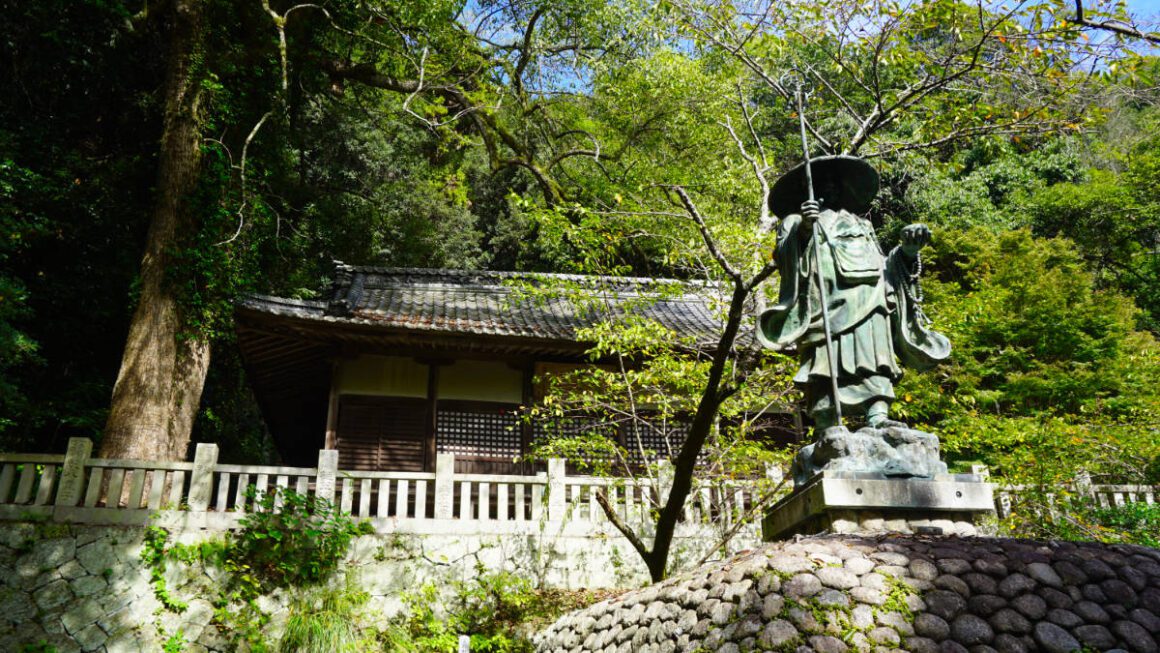
Iyadani-ji is a small temple built on a steep mountainside and is attributed with a number of miracle cures. But even if you’re not looking for miraculous healing, the short climb up its steps is definitely worth the effort. After Iyadani-ji, the route goes east, following a pleasant forest path before ducking under the highway and past a water reservoir. After some roadside walking, you’ll find yourself at Mandala-ji (temple nr. 72). This was once the family temple for the Saeki family, Kobo Daishi’s ancestors. A short distance away, up a short climb, you’ll find Shusshaka-ji (temple nr. 73) with its beautiful, elevated inner courtyard.
If you look up, you’ll see the towering cliffs of Mt. Gahaishi, where it is said Kobo Daishi once jumped off from and made it safely to the ground thanks to the intervention of a heavenly being. Next, you’ll pass Koyama-ji (temple nr. 74), before making it to Zentsuji temple (nr. 75), one of the largest temples on the Shikoku Henro and the birthplace of Kobo Daishi. The town of Zentsuji later developed around this temple to meet the needs of its visitors. After visiting the main temple grounds, you’ll pass through a second courtyard that features an impressive, five-storied wooden pagoda. The structure was first built by Kobo Daishi, but was later destroyed by fire twice, before being rebuilt in its current form.
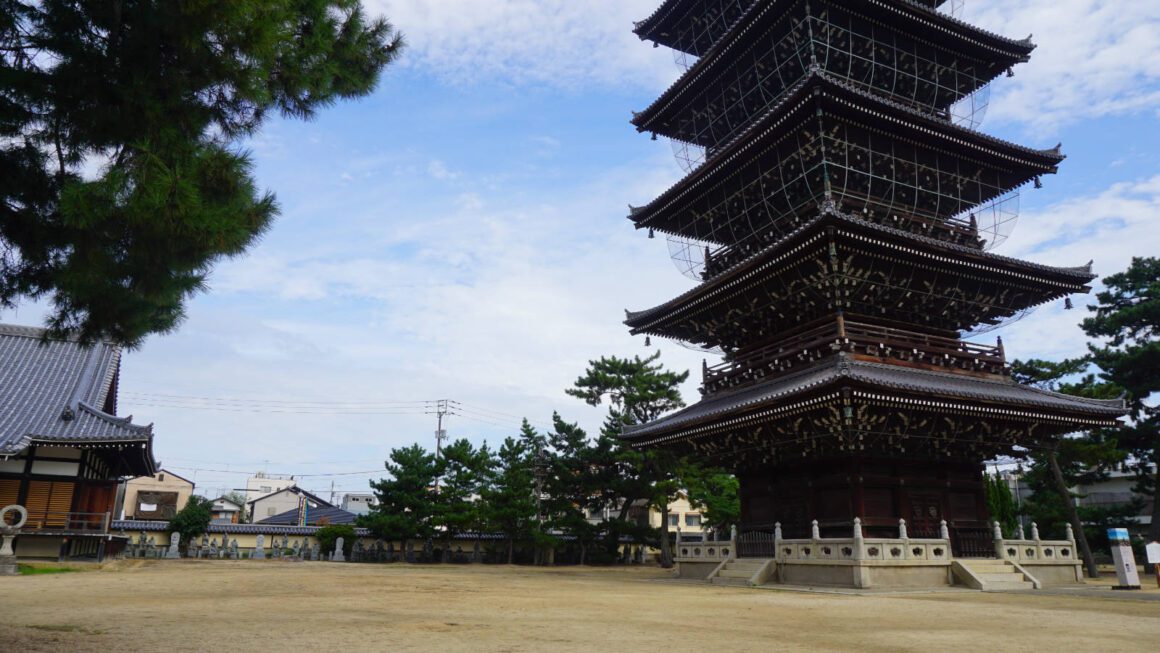
Leave this temple from its eastern exit and keep going straight before turning north along a series of smaller roads and alleyways, going past residential neighbourhoods until you reach Konzoji (temple nr. 76). After visiting this temple, head towards Konzoji station and turn right just before the rail tracks to find Mi Casa Su Casa, your accommodation for the night.
Day 2: Konzoji to Kokubu (temples 77-80)
- Start at: Mi Casa Su Casa
- End at: Seto Kokumin Ryokan (Seto National Inn) – A traditional ryokan (guesthouse) with private tatami-style rooms. Clean, simple facilities. They offer a dinner option, reservations by phone only (+81 8787 4 0353)
- Summary: A long, mostly urban walk that can be a bit underwhelming but also offers a unique, close-up perspective of daily Japanese life, away from tourist hotspots. The route’s proximity to train stations means these urban sections can be skipped to have a shorter day.
Retrace your steps towards Konzoji temple and reconnect with the Shikoku Henro as it turns north and passes through the outskirts of town, through a patch of forest hiding a temple, and into the town of Tadotsu. Here you’ll pass by Doryu-ji (temple nr. 77), a small place of worship seemingly being swallowed up by the surrounding urbanisation. Next, the route heads east, into Marugame city. If you’re short on time (or if you don’t feel like walking this long, urban section) you can choose to take a train from Tadotsu station to Utazu station (which is close to the next temple). However, skipping this section will mean missing your chance to climb the ruins of Marugame castle along the way!
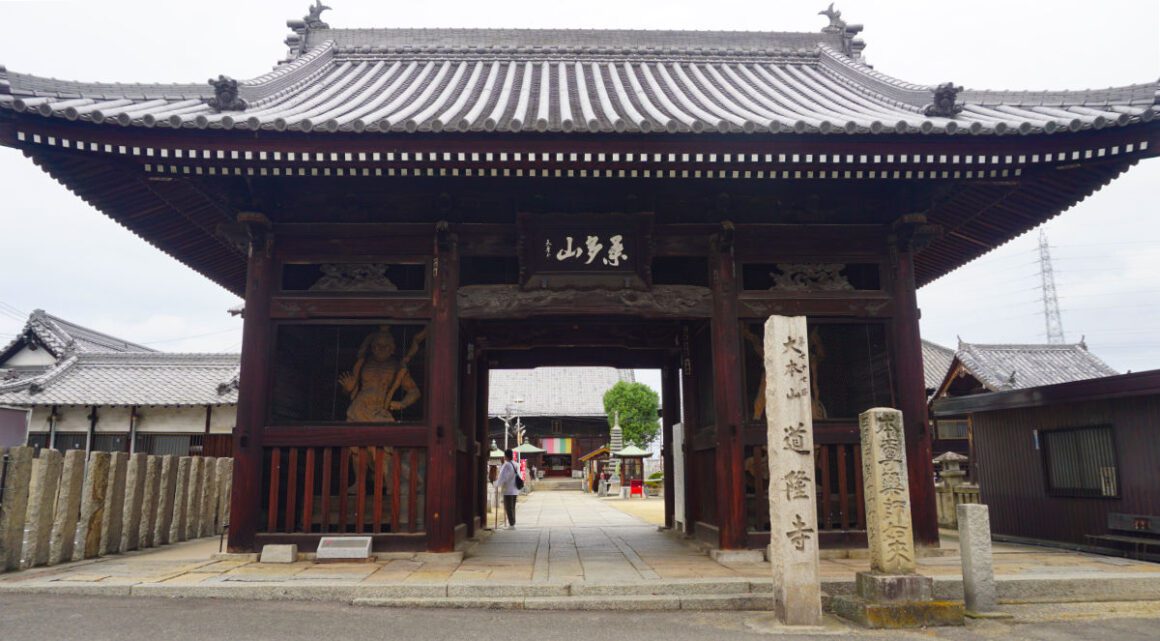
After your visit to Goshoji (temple nr. 78), the route continues on through the town of Sakaide, and this section can also be skipped by taking the train from Utazu station to Yasoba station. However, I would recommend not to skip this part; even though it’s another walk along city streets, this is a much more diverse section that follows smaller, quieter roads. The occasional parks and rest areas only add to the charm of the Japanese provincial atmosphere.
The walk up to Tennoji (temple nr. 79) is especially picturesque. Meaning ‘Temple of the Emperor’, it is named for Emperor Sutoku who was exiled to confinement here in Sakaide in 1156, after a failed rebellion. Feel free to quench your thirst at the healing waters of Yasoba spring before entering the temple (and try not to think about the fact that after his murder in 1164, the exiled emperor’s remains were kept in these waters for a while).
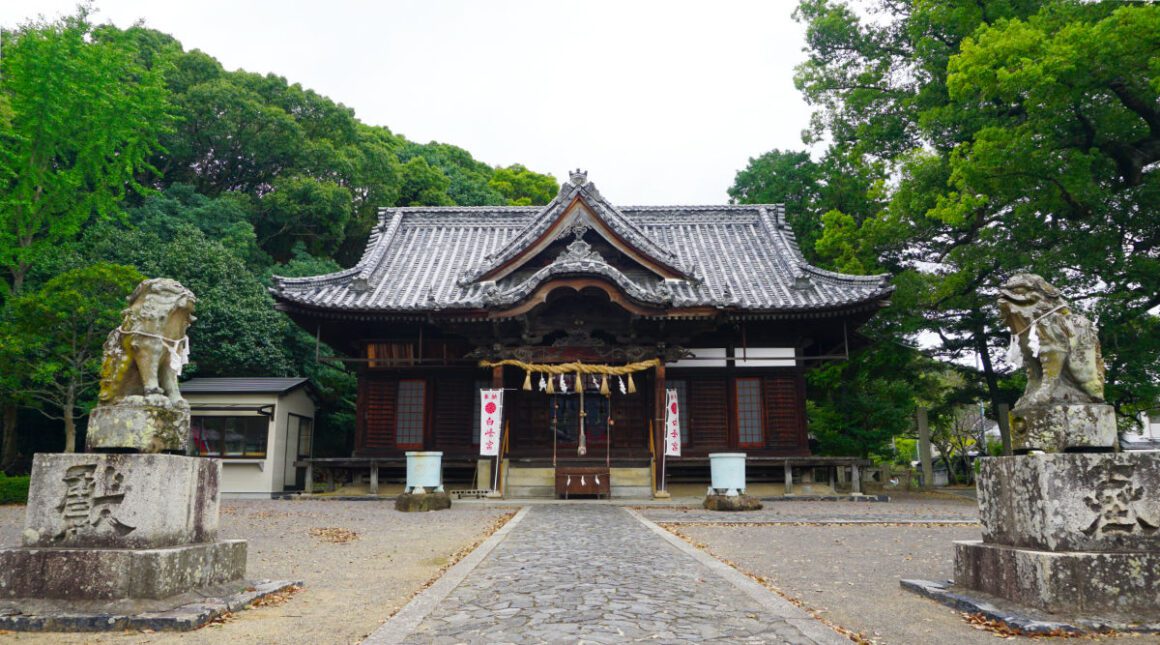
The last few kilometres of this day lead back into greener surroundings, as the trail lightly climbs back into the hills towards Kokubunji temple (nr. 80). Walk a little further east along the provincial road (Route 33) to find Seto Kokumin Ryokan, your guesthouse for the night.
Day 3: Kokubu to Takamatsu (temples 81-83)
- Start at: Seto Kokumin Ryokan
- End at: Kotori Takamatsu – A stylish hostel with coworking space, offering both private rooms and dormitory beds, clean and modern facilities, and friendly, English-speaking staff.
- Summary: A steep stair climb to start the day is rewarded with some of the best nature trails on this part of the Henro. Descend into the outlying urban areas of Takamatsu to reach temple 83. You can choose to skip parts at the end of this day by taking a train to find accommodation in the city (in case accommodation near the end point is booked full).
Note: There are almost no places to get food along this section, except at the start in Kokubu and near the end, on the outskirts of Takamatsu. Make sure to get breakfast and pack a lunch before starting this section!
This day starts with a steep climb into the hills and up a series of winding wooden stairs. At the top of the climb, the forest trail meets an asphalted road where you can turn left to reach Shiromine-ji (temple nr. 81), where you can find the tomb of the exiled emperor Sutoku.
In case you’ve had enough of climbing for the day, you can choose to skip Shiromine-ji and take a shortcut by crossing the road and following another forest trail going north. You’ll miss out on one of the larger temples on the pilgrimage, but you’ll be able to enjoy a serene, alternative route that is rarely taken by other pilgrims. Whichever route you choose, you will eventually end up at a rest area with a shrine, where benevolent locals often leave caches of water and snacks for pilgrims.
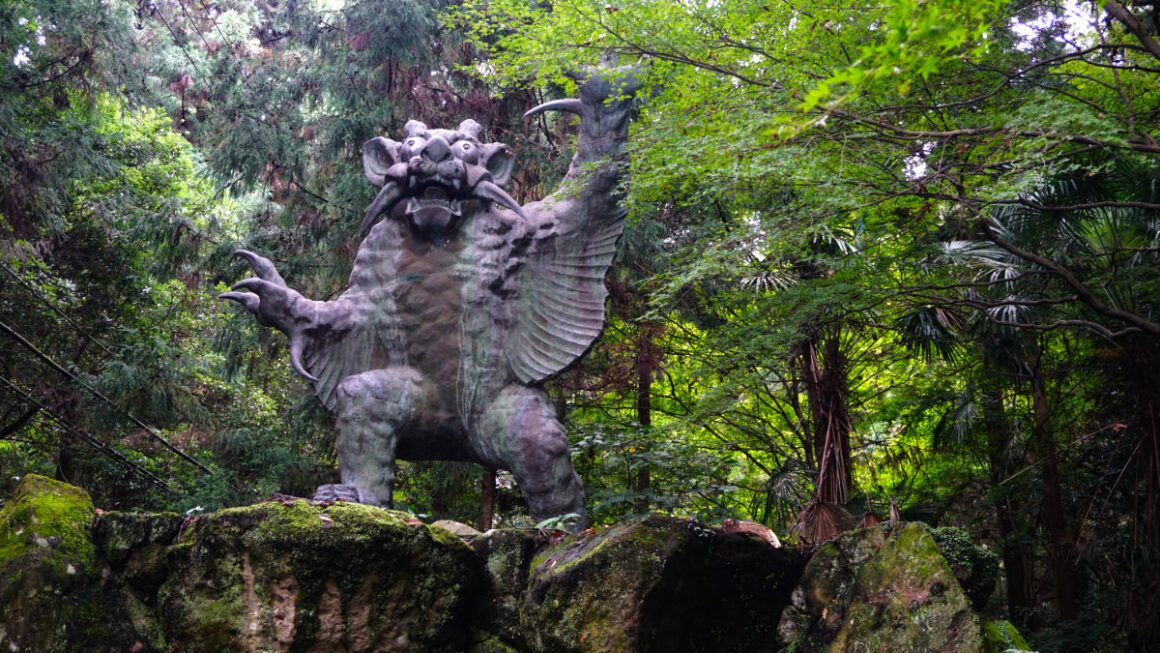
Following the trail further east, you’ll walk along lush jungle trails and a section of asphalt to reach Negoro-ji (temple nr. 82). This impressive mountain temple was built to accommodate ascetic Buddhist practices that exemplify abstinence, isolation, and self-discipline. A 400-year old legend tells of an ‘Ushi-oni’, a demon cow, which once terrorised the area until an expert archer named Yamada Kurando Takakiyo took it down. A statue of this fearsome beast can be found near the entrance to the temple.
Afterwards, you can look forward to more adventurous jungle trails and the occasional stunning views of the Seto Inland Sea, before descending down into Kinashi town and the outskirts of Takamatsu. After an hour or two of walking through residential streets offering glimpses of local daily life, you’ll find yourself at the gates of Ichinomiya-ji (temple nr. 83). Stick your head into the small Yakushi Nyorai shrine if you’re feeling confident about your karma levels. It is said that if you have evil in your heart, you will not be able to pull your head back out!
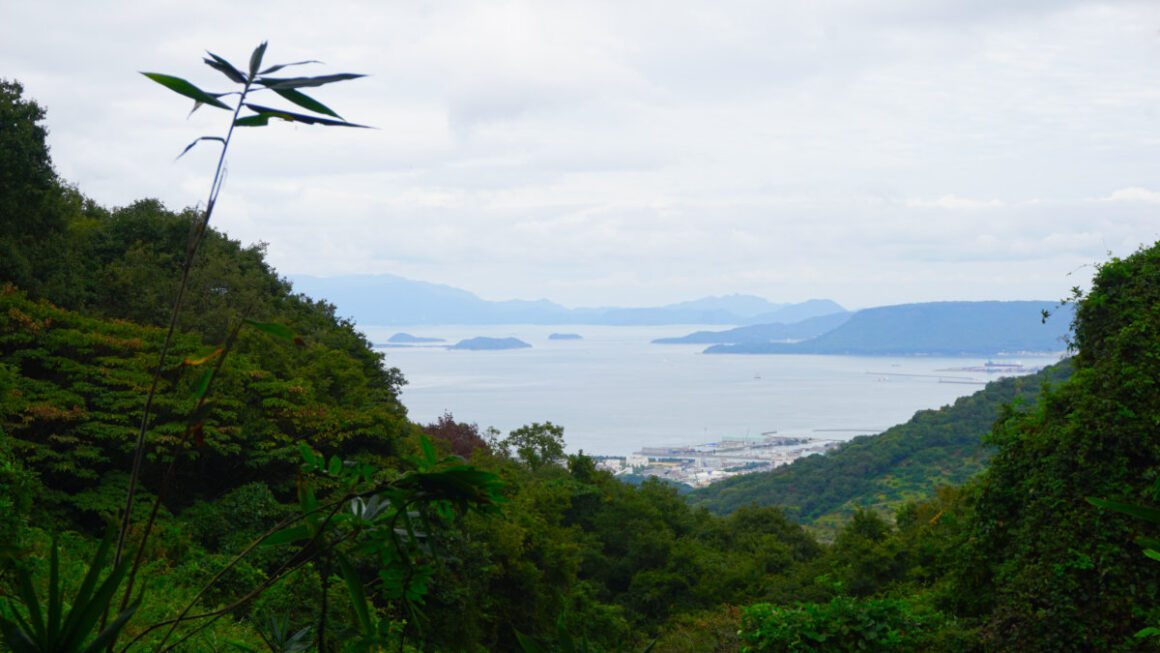
There are only a few accommodation options around Ichinomiya-ji, so your chances of booking a stay are smaller in this area. To avoid a long (and somewhat boring) city walk, you can head to Takamatsu’s city centre by hopping on a train at Ichinomiya station, just south of the temple. Get off at Kawaramachi station to stay at Kotori Coworking & Hostel (they also have a branch in Kotohira) and enjoy the many comforts Takamatsu has on offer.
Day 4: Takamatsu to Shido (temples 84-86)
- Start at: Kotori Takamatsu
- End at: Taiya Ryokan – An affordable ryokan-style guesthouse, with private, tatami-matted rooms and clean facilities. Reservations by phone only: +81 8789 4 0038
- Summary: Skip urban sections by taking a train to Katamoto or Yashima station. Two hilltop temple complexes rule the day, with historical Shikoku Village as a detour option (if you have time). The climbs up each hill aren’t too difficult, as the first one is well paved and the second one can be done with a cable car.
If you spent the night near Ichinomiya-ji (temple nr. 83), you can reconnect with this itinerary by following the official route from the Henro Helper app or by taking a train to Katamoto station to save some time.
It’s a short walk from Kotori to Kawaramachi station, from where you can take a train to Kotoden-Yashima station. This is the fastest way to get out of the city, and it leaves you with enough time to visit the nearby historical open-air museum Shikoku Village. Here you can see what life on Shikoku was like in ages past, inside authentic, restored buildings from different time periods.
If you’re not interested in visiting Shikoku Village, you can take a train to Katamoto station instead, which puts you right back on the official Henro trail. Of course, you can also choose to walk from Takamatsu’s city centre, but this will leave you with less time for exploration and breaks.
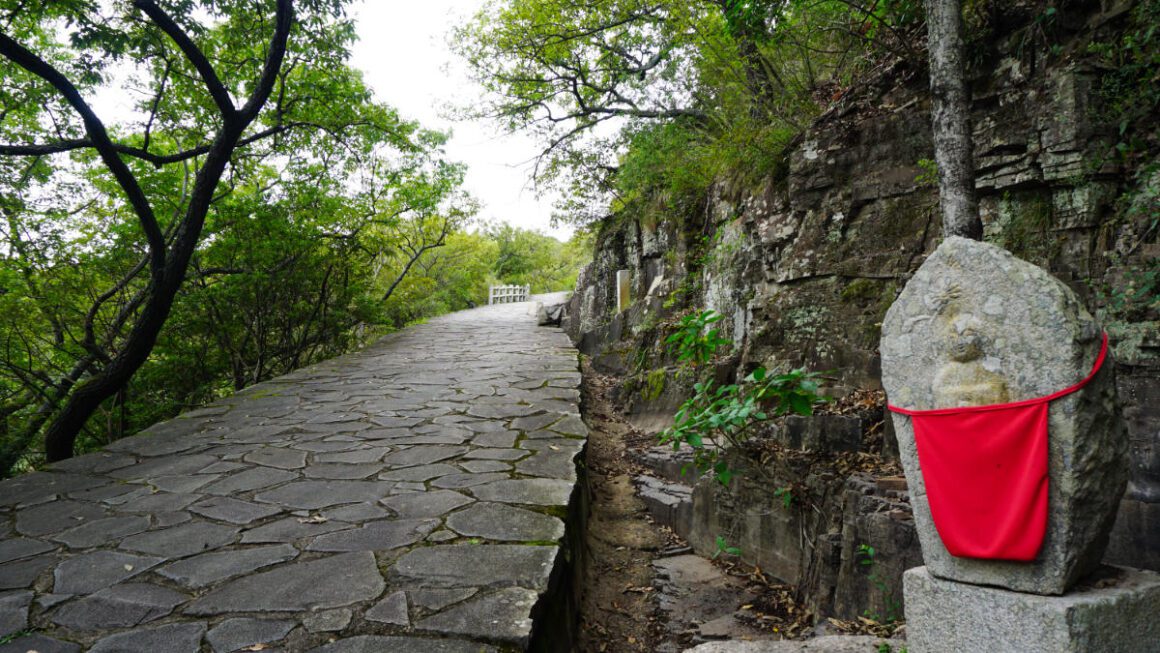
This day is dominated by two hills that need to be climbed to visit the temples (and see the views) at the top. Luckily, both climbs are much easier than yesterday’s staircase. The first uphill section starts near Katamoto station, in the form of a well-paved walking path that snakes its way up to Yashima-ji (temple nr. 84). Afterwards, the trail descends steeply towards the city below before crossing the water and making its way towards the second hill of the day.
This second uphill section can actually be skipped by taking the Yakuri Cable Car straight to the Yakuri temple grounds. Those willing to make the climb on foot will find themselves rewarded with bragging rights and satisfaction as they enter Yakuri-ji (temple nr. 85) through its main gate. Regardless of how you got up, you will discover one of the most impressive temples on this itinerary. Yakuri-ji is built onto the slopes of Mt. Goken, half-hidden below the verdant canopies of great trees, some of which are said to have been planted by Kobo Daishi himself.
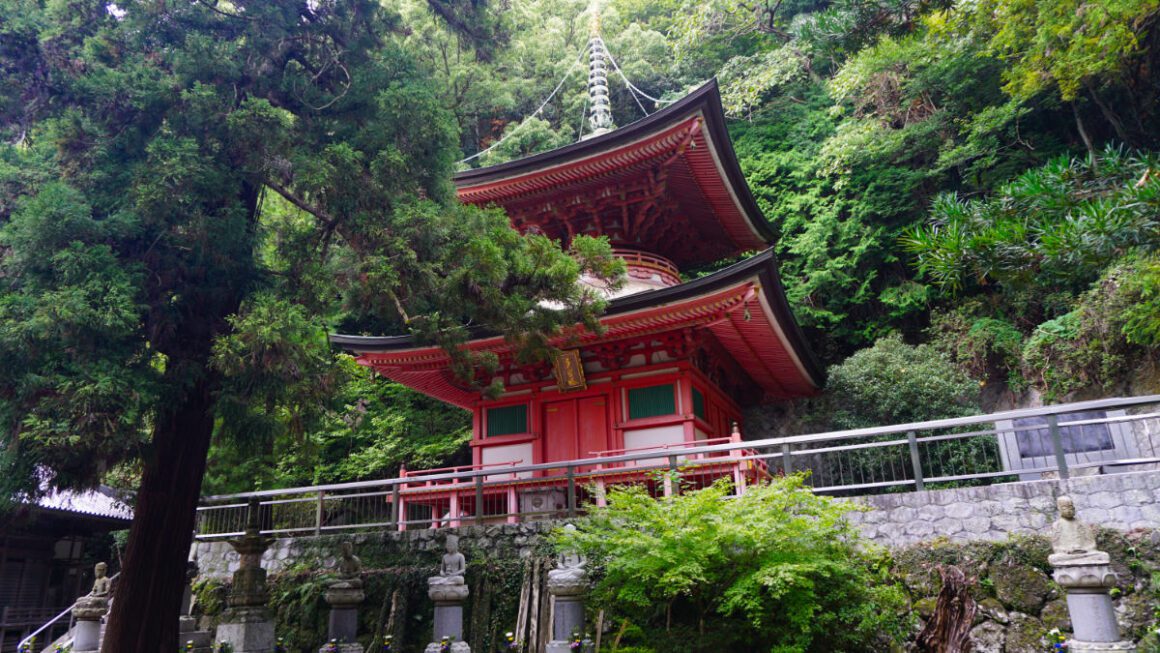
From here, the Shikoku Henro follows an asphalted road south, down the mountain and towards the coast. After a few kilometres of walking past industrial zones followed by picturesque coastal neighbourhoods, you’ll find yourself in Shido, a small coastal town swallowed up by Sanuki city. Here you can visit Shido-ji (temple nr. 86). After your visit you can retrace your steps and rest your feet at Taiya guesthouse.
Day 5: Shido to Okubo-ji (temples 87-88)
- Start at: Taiya Ryokan
- End at: Yasukobo guesthouse (if staying near Okubo temple) or Nagaozi guesthouse (if taking the bus back to Nagaonishi).
- Summary: Have an early start to get the most out of this day. Take a train to Zoda station to gain more time. After Nagao-ji (temple nr. 87) the trail leads into the hills for a long, steady climb towards Okubo-ji (temple nr. 88). A more challenging, but more scenic alternative route to Okubo-ji can be taken from the Henro museum.
Alternative route:
Note: if you’re not spending the night near Okubo-ji (temple nr. 88) on your last day, it is important to arrive (and finish) at this temple before 4 pm, when the last bus of the day leaves. There are no other transportation options available after this time, except for taking a taxi.
This last day on the Shikoku Henro can be a long one (almost 7 hours of walking), but you can choose to skip part of this day by taking a train from Shido station to Zoda station to shave off an hour or two. However, it’s always a good idea to start early (around 7 am) if you’re not spending the night near Okubo temple, as the last bus back to the city leaves from the temple at 4 pm.
The day starts by following a provincial road (Route 3) to cross the hills south of Shido, where the Shikoku Henro passes through agricultural outskirts before entering Nagaonishi, where Nagao-ji (temple nr. 87) acts as the last official stop before the end of this pilgrimage. The bus from Okubo temple at the end of the Shikoku Henro trail will take you back to this town.
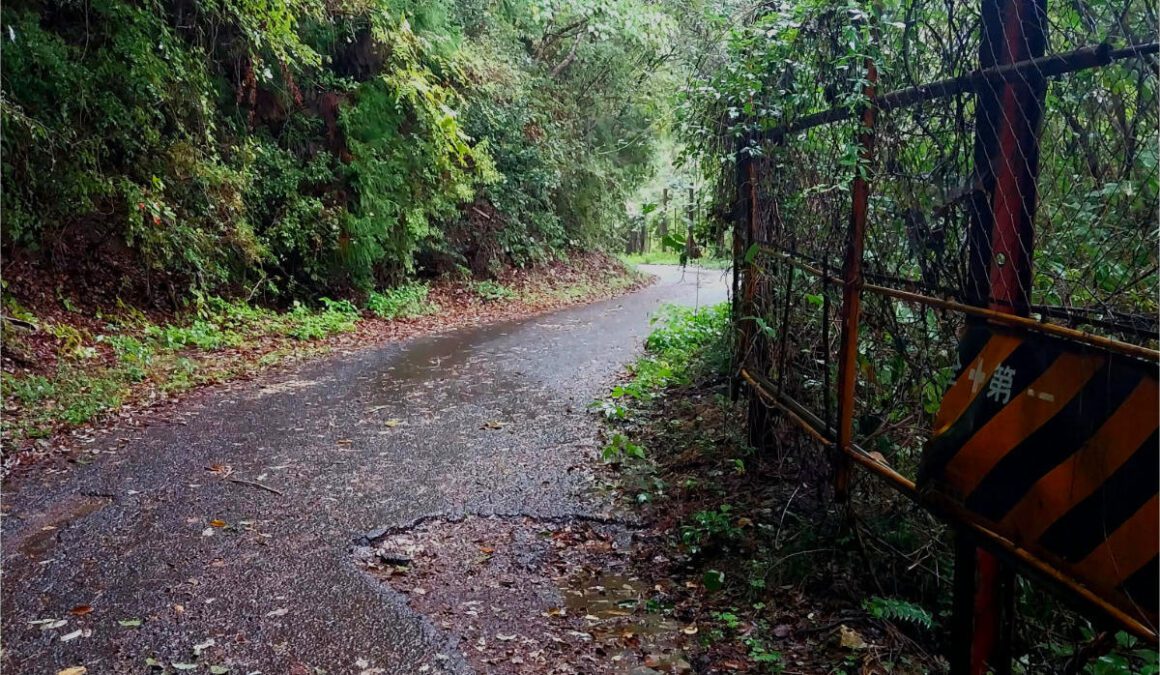
After Nagao-ji, the route keeps going south until it reaches the foothills of the Sanuki mountain range. Here, the Shikoku Henro climbs its way up on quiet roads that leave the city behind and wind their way through the lush jungle that covers these hills. After a short, gentle climb you’ll reach a rest stop near the Kabe river reservoir. Here you can take a break and check out the Ohenro Museum, offering an impressive collection of historical pilgrim artifacts, stamp books, clothing, and a scale model of Shikoku that shows the entire pilgrimage and its 88 temples.
To continue, you have two options. The first option is to follow the official Shikoku Henro trail directly south, up a winding road that climbs steadily for about 4 kilometres before joining Route 3 and Route 377 as it approaches Okubo-ji (temple nr. 88) at the end. This route is less difficult, but will have you walk on asphalted roads (some of which can be heavy with traffic) until you reach a rest stop. From this rest stop, you can skip busy Route 377 by heading northeast along a byroad. Go past a number of industrial buildings until you reach a partially overgrown trail through the jungle, which offers a safer and slightly more adventurous way to connect with the road leading up towards Okubo-ji.
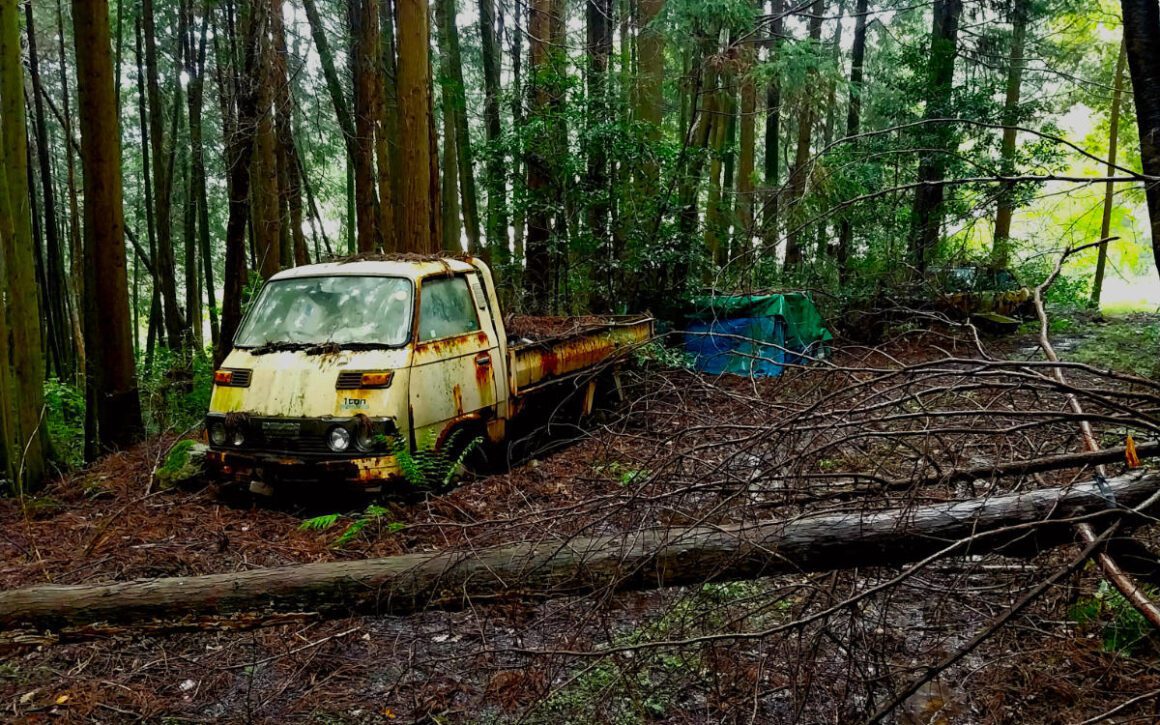
The second option is to head east from the Ohenro Museum and follow a slightly more challenging alternative route into the hills. This way is often the more popular option for pilgrims, as it bypasses the busy roads completely and approaches Okubo-ji from the north after climbing up jungle paths and quiet backroads. Be aware that some parts of this alternative route are offroad hiking trails, which can get muddy, slippery, and hard to climb during or after rainy weather.
Whichever route you decide to take, you’ll eventually reach Okubo-ji (temple nr. 88) at the end of the pilgrimage. This beautiful temple complex, hidden away on the lush slopes of Mt. Nyotai, is the official end of the Shikoku Henro trail. Besides being a welcome sight for weary pilgrims, it also features an enclosure housing a large collection of pilgrim staffs that marks the spot where Kobo Daishi once left his own (you can add yours to the pile, for a fee of 1000 yen).
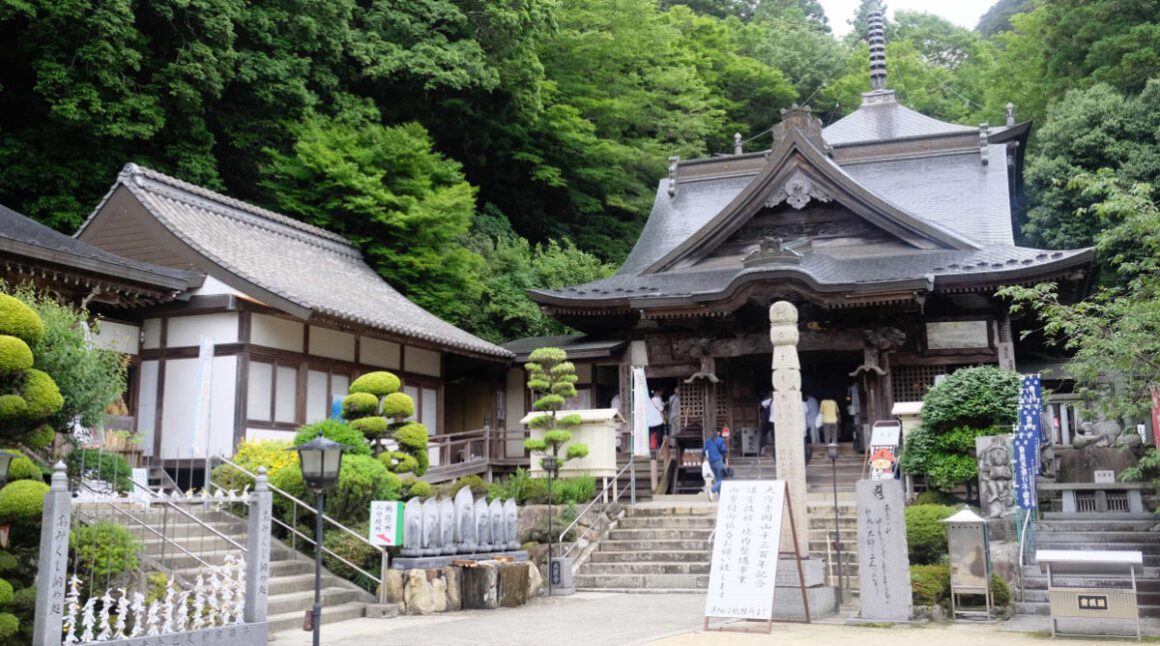
To stay the night, you can try and get a reservation at Yasokubo guesthouse. However, as the only available guesthouse near the end of the Shikoku Henro trail, this place tends to be fully booked. Make your reservation well in advance, or take the bus (latest departure at 4 pm) from the Okuboji bus stop back to Nagaonishi. From there, you can take a train to Takamatsu city or Kotohira from Nagao station, or stay at Nagaozi guesthouse (and take the train the next day).